
Documentation Index
Fetch the complete documentation index at: https://docs.evergreens.ai/llms.txt
Use this file to discover all available pages before exploring further.

Overview
Sources are the websites and content that AI platforms cite when answering questions. Understanding sources helps you identify:- Where AI gets information about your industry
- Which content influences AI recommendations
- Where competitors appear but you don’t (opportunities!)
Source Types
Domain Types
AI Brand Monitor classifies domains into categories:| Type | Description | Examples |
|---|---|---|
| You | Your brand’s websites | yourcompany.com |
| Competitor | Competitor websites | competitor.com |
| Corporate | Other company sites | microsoft.com, google.com |
| Editorial | News, blogs, magazines | techcrunch.com, forbes.com |
| UGC | User-generated content | reddit.com, quora.com |
| Reference | Knowledge bases | wikipedia.org, docs.* |
| Institutional | Government, education | .gov, .edu sites |
| Other | Uncategorized | Everything else |
URL Types
Individual pages are classified by content type:| Type | Description | Examples |
|---|---|---|
| Homepage | Main entry pages | company.com/ |
| Product Page | Product/service pages | …/pricing, …/features |
| Article | News and blog posts | …/blog/… |
| Listicle | ”Top 10…” articles | ”Best CRM tools 2026” |
| Comparison | A vs B articles | ”Salesforce vs HubSpot” |
| How-To Guide | Tutorials | ”How to set up…” |
| Alternative | Alternative roundups | ”Best X alternatives” |
| Discussion | Forum threads | Reddit posts, Quora answers |
Sources Dashboard
Domains Tab
Shows aggregated data by domain:| Column | What It Shows |
|---|---|
| Domain | Website domain name |
| Type | Domain classification |
| Used | Number of chats citing this domain |
| Used % | Relative to most-cited domain |
| Avg Citations | Average times cited per chat |
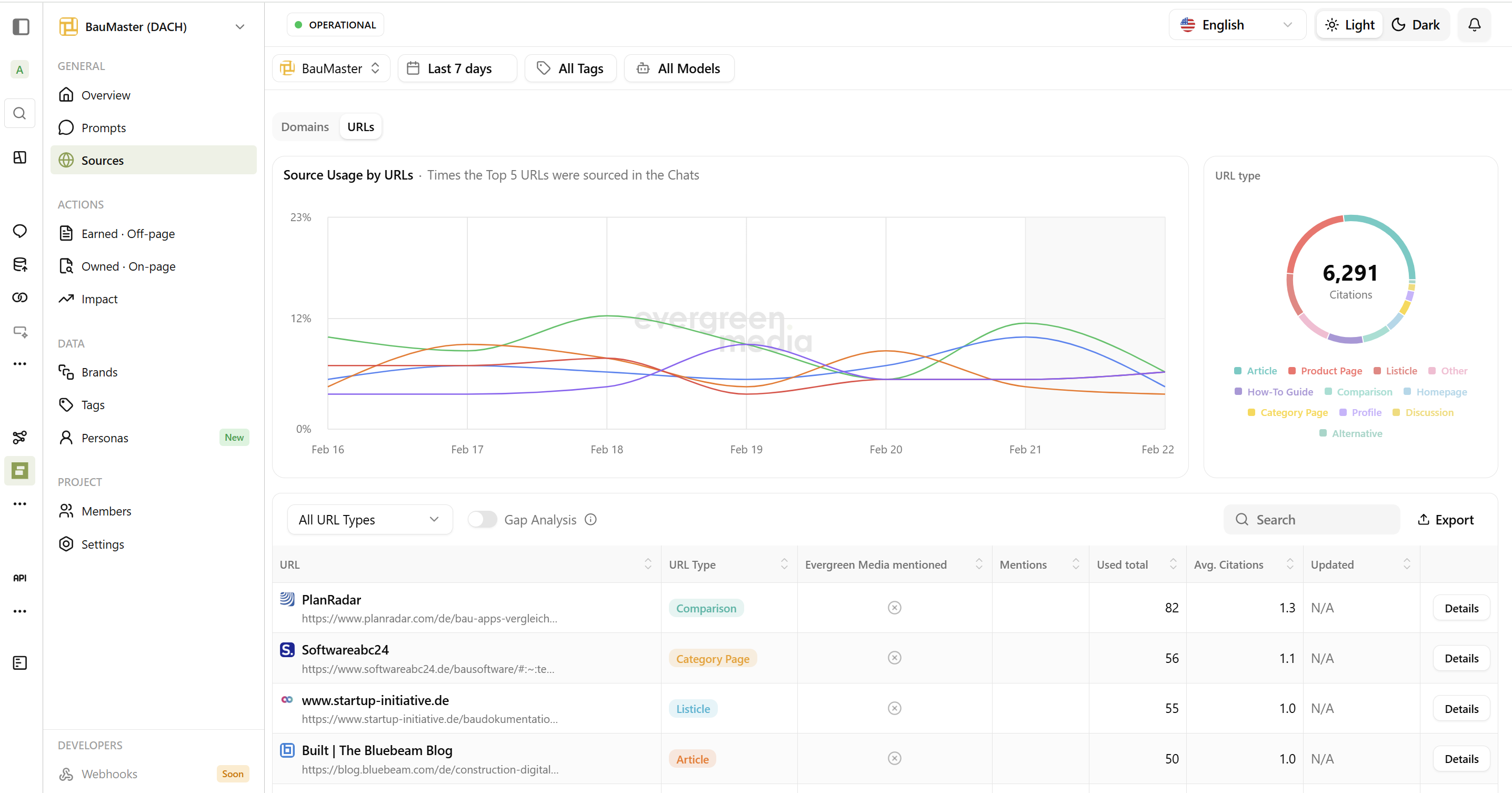
URLs Tab
Shows individual page data:| Column | What It Shows |
|---|---|
| URL | Full page URL |
| Title | Page title |
| Type | Content type classification |
| Brand Mentioned | Whether your brand appears on this page |
| Used | Number of chats citing this URL |
Type Distribution
The pie chart shows how citations break down by type:What to Look For
- High Editorial % - AI relies heavily on news/blog content
- High UGC % - AI values user opinions and discussions
- High Competitor % - Competitors have strong owned content
- Low “You” % - Opportunity to create more citable content
Usage Chart
The line chart shows how top sources trend over time:
- Rising sources - Becoming more influential
- Falling sources - Losing relevance
- New sources - Recently started being cited
Gap Analysis
Gap Analysis helps you find sources where competitors appear but you don’t - these are your best opportunities!
How to Use Gap Analysis
Understanding Gap Score
- Source cited 50 times
- Mentions 3 competitors but not you
- Gap Score = 50 × 3 = 150
Min Competitors Filter
Adjust the minimum competitor count to focus your efforts:| Setting | What You’ll See |
|---|---|
| 1 | Any source with at least 1 competitor |
| 2+ | Sources where multiple competitors appear |
| 3+ | High-competition sources (hardest to crack) |
Why Sources Matter
Understanding AI Influence
AI platforms learn from content across the web. When answering questions, they cite sources to support recommendations. These citations reveal:What AI Trusts
High-authority sources that AI considers reliable
What AI Learned
Content that shaped AI’s knowledge base
What AI Recommends
Action-driving content that leads to recommendations
Most Influential Source Types
| Type | Influence Level | Why |
|---|---|---|
| Editorial (News/Blogs) | Very High | AI treats journalistic content as authoritative |
| Comparison Sites | High | Directly answers “best of” questions |
| Reviews (G2, Capterra) | High | Trusted third-party opinions |
| UGC (Reddit, Quora) | Medium | Real user experiences |
| Your Website | Medium | Good for branded queries |
| Wikipedia | Medium | Background/definition queries |
Taking Action on Sources
When You Find a Gap
Check the content type
- Editorial: Consider outreach, PR, or creating newsworthy content
- Comparison/Listicle: Reach out to the author
- UGC: Participate authentically in discussions
- Review sites: Encourage customer reviews
Best Practices
Focus on Influence
Prioritize sources that AI cites frequently, not just any source where competitors appear.
Quality Over Quantity
Better to get mentioned well on 5 influential sources than barely on 50 low-impact ones.
Track Progress
Revisit the Sources dashboard monthly to see if your efforts are paying off.
Think Long-Term
Source influence changes over time. What’s important today may shift.